
When a flooded electrical room occurs, the damage is immediate, serious, and rarely limited to just one component. Flooding is the single most common cause of emergency circuit breaker failure, and it affects both modern and legacy electrical systems alike. Whether water enters the space due to burst pipes, frozen plumbing, stormwater intrusion, or infrastructure failure, once breakers are exposed to moisture, they are no longer safe to operate. In these situations, circuit breaker failure from flooding is not a possibility — it is an expectation.
Flooding impacts electrical systems across all industries, and it does not discriminate by brand or age. Facilities operating with legacy breakers from Federal Pioneer, Westinghouse, General Electric, Canadian General Electric (CGE), CGE Magna Blast, or Amalgamated Electric are just as vulnerable as those using newer equipment. In fact, older breakers are often at greater risk because replacement options are assumed to be limited when water damage occurs.
When water enters a breaker, internal corrosion begins almost immediately. Contacts degrade, insulation breaks down, and mechanical components seize or misalign. Even if the breaker appears functional after drying, hidden moisture contamination makes failure under load highly likely. This is why electricians and inspectors treat flooded electrical panel breaker replacement as an emergency and require immediate action.
Facilities commonly experience flood-related breaker failures across a wide range of manufacturers, including Siemens, ITE, Sylvania, Bulldog, Commander, CEB, Pringle switches, Bolt switches, Bolt Lock, and Pressure Lock switches. These brands are frequently found in older commercial, industrial, and institutional buildings where electrical rooms are located below grade. Fast breaker replacement after flooding becomes critical.
A major challenge after flooding is that many of these breakers are obsolete or discontinued. Standard suppliers often cannot source replacements for Square D legacy breakers, Cutler-Hammer and Eaton vintage breakers, Pushmatic, Taylor Electric, Hydel, or Schneider Electric older models quickly — if at all. This is where facilities lose valuable time and are pushed toward costly retrofits.
RS Breakers solves this problem by maintaining extensive inventory across all major and legacy brands. We stock breakers from ABB, SACE, Asea Brown Boveri, Klockner Moeller, and Schneider Electric, along with hard-to-find models from discontinued manufacturers. This allows RS to provide emergency circuit breaker delivery for flooded electrical rooms without forcing redesigns or modifications.
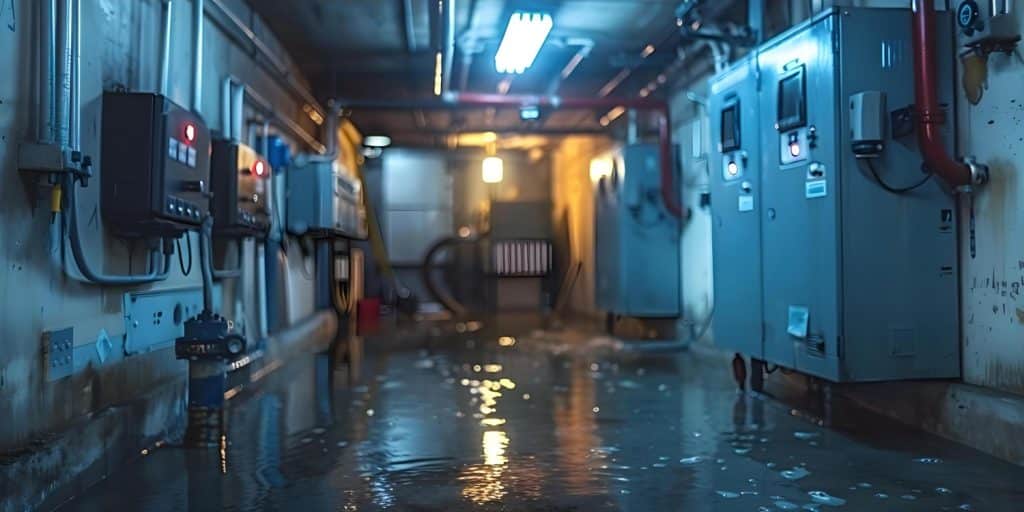
Flooding does not only affect breakers directly submerged in water. Moisture migration, condensation, and contaminated air can damage breakers mounted higher in panels as well. This is why emergency breaker replacement often involves multiple breakers, not just one. Electricians inspecting flooded rooms frequently identify failures across entire breaker lineups once testing begins.
Another common mistake after flooding is attempting to reuse breakers that “look fine.” Breaker water damage is not always visible, but the risk remains. Inspectors and insurers do not accept visual inspection alone when water exposure has occurred. Like-for-like breaker replacement after water damage is required to expeditiously restore compliance and safety.

Facilities using like-for-like circuit breaker replacement after flooding benefit from faster restoration and reduced risk. When the correct breaker is available, power can often be restored the same day or next day. RS Breakers’ ability to source breakers from Federal Pioneer, Westinghouse, GE, CGE, Siemens, Eaton, Square D, Cutler Hammer, and many others eliminates unnecessary delays.
Understanding how flooding affects breakers across different brands is the first step toward recovery. The next challenge often appears once power is restored, when breakers that survived flooding fail under renewed demand. In the next section, we’ll examine why breakers commonly fail after power outages and during cold weather load surges, and how these conditions create urgent replacement needs even when flooding is no longer visible.

While flooding is the leading cause of emergency breaker failure, a close second — and often more misunderstood — is what happens after a power outage. Many facilities assume that once electricity is restored, operations can simply resume. In reality, breaker failure after a power outage is extremely common, especially in older electrical systems and during cold weather events.
When power goes out, electrical systems experience a sudden drop to zero load. When power is restored, that load returns instantly — and often at a much higher level than normal. Heating systems, motors, compressors, and industrial equipment all attempt to restart at the same time. This sudden surge places enormous stress on circuit breakers, particularly those that are aging or already operating near capacity. As a result, breakers frequently fail when power comes back on.
This is one of the most common reasons facilities require emergency circuit breaker replacement after power restoration. Breakers may trip repeatedly, fail to reset, or suffer internal damage that prevents safe operation. In many cases, a breaker that appeared functional before the outage becomes unreliable or unusable once full electrical demand returns.
Cold weather dramatically increases this risk. During extreme temperatures, electrical demand rises across commercial and industrial facilities. Heating systems run continuously, motors work harder, and overall electrical load increases. Cold weather breaker failure is especially common in older facilities that were never designed for modern energy demands. When combined with a power outage, these conditions create a perfect storm for breaker failure.

Another common scenario occurs when breakers trip multiple times during or after an outage. Repeated tripping is not harmless. Each trip generates heat and mechanical stress inside the breaker. Over time — or even within a single outage event — this stress can cause internal components to degrade. When that happens, the breaker may no longer provide proper protection, making emergency breaker replacement the only safe option.
Facilities are often caught off guard by these failures because the damage isn’t always obvious. A breaker may reset temporarily, only to trip again under load. In other cases, breakers appear operational but fail inspection once electricians test them. This is why breaker failure during power restoration frequently leads to urgent calls for emergency circuit breakers.
Unfortunately, this is also where delays often occur. Many facilities rely on standard suppliers who do not stock older or discontinued breakers. When those breakers fail after a power outage, replacement options appear limited, and retrofitting is suggested as the only solution. This can turn a short outage into days or weeks of downtime.
RS Breakers eliminates that delay by maintaining extensive inventory specifically for these situations. With a large stock of rare and obsolete circuit breakers, RS can support emergency circuit breaker delivery when power restoration causes unexpected failures. Same-day or next-day delivery allows facilities to respond immediately rather than escalating the problem.

It’s important to understand that breaker failure after a power outage is not a sign of poor maintenance — it’s a predictable outcome of electrical stress, especially during cold weather. Aging breakers, increased load, and sudden restoration all contribute. The key is responding correctly and quickly.
Before committing to retrofits or modifications after a power outage, facilities should determine whether a like-for-like circuit breaker replacement is available. In many cases, replacing the failed breaker restores full functionality without redesigning the electrical system or increasing insurance exposure.
Once power outages and cold weather load failures are understood, another category of emergency risk becomes clear — damage caused by external events such as storms, fires, and infrastructure failures. In the next section, we’ll explore how disasters, environmental stress, and utility disturbances impact breakers and why emergency inventory becomes critical when supply chains are strained.
Beyond flooding and power outages, many emergency circuit breaker failures are triggered by external events that place sudden and extreme stress on electrical systems. Storms, hurricanes, forest fires, utility disturbances, and broader infrastructure damage all contribute to breaker failure — often in ways that aren’t immediately visible. In these situations, access to emergency electrical supplies and fast decision-making become critical.
Severe storms and hurricanes frequently cause breaker failure after storm events. High winds, heavy rain, and lightning strikes can introduce voltage irregularities, physical vibration, and moisture intrusion into electrical systems. Even when water does not directly flood an electrical room, breakers can still be damaged by humidity, condensation, or electrical surges caused by unstable utility supply. These conditions often result in breakers that trip repeatedly, fail under load, or no longer meet safety requirements.
Forest fires and large-scale fires introduce a different but equally serious risk. Heat, smoke, ash, and airborne contaminants can penetrate electrical enclosures and damage internal breaker components. Fire-damaged electrical breakers may appear intact externally while suffering internal degradation that compromises their ability to protect circuits safely. In these cases, electricians and inspectors typically require immediate emergency breaker replacement, even if the fire did not directly reach the electrical room.
Utility infrastructure failures also play a major role in emergency breaker scenarios. Grid instability, voltage spikes, brownouts, and rapid fluctuations during restoration can cause circuit breaker failure after utility surges. These disturbances place stress on breaker contacts, trip mechanisms, and internal insulation. Older breakers are particularly vulnerable, as they were not designed to tolerate modern grid conditions or repeated surge events.
One of the most challenging aspects of disaster-related breaker failure is timing. Disasters create regional demand spikes for emergency electrical supplies, while supply chains are often strained or disrupted. Standard suppliers quickly run out of stock or face extended lead times. When this happens, facilities are left with limited options and growing downtime.
This is where inventory depth becomes a deciding factor.
RS Breakers maintains extensive stock of emergency circuit breakers, including rare, obsolete, and discontinued models, specifically to support disaster-related failures. When storms, fires, or infrastructure damage occur, RS can often provide emergency circuit breaker delivery when other suppliers cannot. Having breakers available immediately allows facilities to avoid prolonged outages during already disruptive events.
Another complication during disaster scenarios is uncertainty. Damage is not always obvious. Breakers may function temporarily, only to fail hours or days later once systems return to full load. This delayed failure often catches facilities off guard, especially after power has already been restored. When breakers fail under these conditions, the need for emergency breaker replacement becomes urgent.
In the aftermath of disasters, facilities are often pressured to make fast decisions under incomplete information. This is when costly mistakes happen. Retrofitting, panel modifications, or system redesigns may be recommended without fully understanding the root cause of the failure. These approaches dramatically increase downtime and introduce unnecessary complexity at the worst possible moment.
In many disaster-related cases, the original system design remains sound. The failure is isolated to specific breakers that were damaged by environmental stress. When that’s the case, a like-for-like circuit breaker replacement is often the fastest, safest, and most compliant solution. The challenge is knowing whether that option is available — and making that determination before committing to long-term modifications.
RS Breakers helps facilities make that call quickly. With technical expertise and deep inventory, RS can identify whether a like-for-like circuit breaker replacement is possible and deliver it immediately. This capability is especially valuable during disasters, when time, safety, and operational continuity are all at risk.
Understanding how disasters and environmental stress damage breakers is essential. But understanding the cause alone isn’t enough. The most important decision comes next: choosing the right response. In the final section, we’ll explain why understanding the failure before retrofitting or modifying your system can save days or weeks of downtime — and how making the right call early keeps emergencies from escalating further.
After flooding, power outages, cold weather load failures, or disaster-related damage, facilities are often forced to make decisions quickly. Power is down, operations are disrupted, and pressure is coming from every direction. In these moments, one of the most costly mistakes is acting before fully understanding why the circuit breaker or switchgear failed. The decision made at this stage determines whether power is restored in hours — or whether downtime stretches into days or weeks.
In emergency situations, it is common for facilities to be told that a retrofit, panel modification, or bus bar change is required. These recommendations are often made under urgency, not because they are the best solution, but because the correct replacement component is assumed to be unavailable. Once that assumption is made, retrofitting becomes the default path — even though it introduces significant delays.
The reality is that most emergency circuit breaker failures do not automatically require retrofitting. Whether the failure was caused by a flooded electrical room, a breaker failing after power restoration, cold weather electrical load stress, or disaster-related environmental damage, the original system design is often still valid. In many cases, only the failed circuit breaker, switchgear component, generator circuit breaker, bus plug, or MCC bucket needs to be replaced.

This is why understanding the root cause of failure is critical before committing to any modification. Water damage, load surges, voltage irregularities, and environmental stress affect different components in different ways. Misdiagnosing the issue can lead to unnecessary work, extended downtime, and higher costs — all while the facility remains offline.
A key factor that drives premature retrofitting is availability. When standard suppliers cannot source older or discontinued circuit breakers or switchgear components quickly, retrofitting appears to be the only option. This is especially common after floods, storms, or widespread power outages, when demand for emergency electrical supplies increases and inventories are depleted.
RS Breakers changes this equation by maintaining extensive stock of rare, obsolete, and discontinued electrical equipment. Because RS already has inventory across all vintages, many situations that appear to require retrofitting can instead be resolved with a like-for-like circuit breaker replacement or like-for-like replacement of switchgear components, generator circuit breakers, MCC buckets, or bus plugs (fusible). This approach restores power faster, avoids redesigns, and minimizes risk.
Choosing a like-for-like circuit breaker replacement has several critical advantages in emergency situations. It preserves the original electrical configuration, which inspectors and insurance providers prefer. It avoids engineering reviews, panel alterations, and approval delays. Most importantly, it significantly reduces downtime. In emergencies caused by flooding, cold weather, or power outages, speed is everything — and like-for-like replacement is consistently the fastest solution.
Another overlooked risk of rushing into retrofits is insurance exposure. Modifying electrical systems under emergency conditions can trigger additional scrutiny and, in some cases, increased premiums. By contrast, like-for-like replacement of circuit breakers, switchgear, MCC buckets, or generator circuit breakers restores the system to its approved state, reducing complications during inspections and insurance reviews.
RS Breakers supports facilities at this decision point by providing clarity when it matters most. With deep technical expertise and a massive emergency inventory, RS can quickly determine whether a like-for-like circuit breaker or switchgear replacement is available and coordinate emergency circuit breaker delivery when time is critical. This allows facilities to make informed decisions rather than reactive ones.
Before committing to a retrofit, it’s essential to ask one question: is the correct replacement component available right now? In many cases, the answer is yes — and acting on that information can prevent unnecessary downtime and expense.
Understanding the cause of failure is the foundation. Choosing the right response is the turning point. This is why like-for-like replacement is almost always faster than retrofitting, how it applies to circuit breakers, switchgear, and motor control equipment, and why experienced electricians call RS before making any modification decisions.